
Apr 24, 2016
Snowy Oal

Apr 16, 2016


Apr 2, 2016
What is Time?

Time is conscious experience of duration, the period
during which an action or event occurs. Time is also a dimension representing a
succession of such actions or events. Time is one of the fundamental quantities
of the physical world, similar to length and mass in this respect. The concept
that time is a fourth dimension—on a par with the three dimensions of space:
length, width, and depth—is one of the foundations of modern physics. Time
measurement involves the establishment of a time scale in order to refer to the
occurrence of events. The precise determination of time rests on astronomical
and atomic definitions that scientists have established with the utmost
mathematical exactness.
Physicists agree that time is one of the most difficult
properties of our universe to understand. Although scientists are able to
describe the past and the future and demarcations such as seconds and minutes,
they cannot define exactly what time is. The scientific study of time began in
the 16th century with the work of Italian physicist and astronomer Galileo
Galilei. In the 17th century English mathematician and physicist Sir Isaac
Newton continued the study of time. A comprehensive explanation of time did not
exist until the early 20th century, when German-born American physicist Albert
Einstein proposed his theories of relativity. These theories define time as the
fourth dimension of a four-dimensional world consisting not just of space but
of space and time.
Several ways to measure time are in use today.
Solar time is based on the rotation of Earth on its axis. It makes use of the
Sun’s apparent motion across the sky to measure the duration of a day. Sidereal
time is also based on Earth’s rotation, but uses the apparent motion of the
“fixed” stars across the sky as Earth rotates as the basis for time
determination. Standard time, the familiar clock time most people use in
everyday life, is based on the division of Earth’s sphere into 24 equal time
zones. Dynamical time—formerly called ephemeris time—is the timescale of
astronomy. Astronomers use the orbit of Earth around the Sun, as well as the
orbital motions of the Moon and the other planets, to determine dynamical time.
Atomic time is based on the frequency of electromagnetic waves that are emitted
or absorbed by certain atoms or molecules under particular conditions. It is
the most precise method for measuring time.
(Encarta Encyclopedia)
Mar 26, 2016
Insects
 We live in an age of insects.
About half of all known animals are insects. Scientists have found about 1
million species (kinds) of insects so far. There are more species of
insects than of any other animal in the world. Bees, flies, ants, grasshoppers,
beetles, and butterflies are some of the insects that might live near you.
We live in an age of insects.
About half of all known animals are insects. Scientists have found about 1
million species (kinds) of insects so far. There are more species of
insects than of any other animal in the world. Bees, flies, ants, grasshoppers,
beetles, and butterflies are some of the insects that might live near you.
Insects buzz in the air. They crawl over
stones. They hop through grass. They dig tunnels underground.
Some insects are helpful. They do important
jobs to help plants grow. They help get rid of wastes and dead plants and
animals. Some insects are harmful. They bite or sting. They carry diseases or
destroy crops.
What Makes an Insect an Insect?
Insects are invertebrates, or animals without
backbones. They breathe air through holes in their bodies. The body of an
insect has three main parts called the head, thorax, and abdomen.
Insects go through life stages and have very
different forms in each stage. Adult insects usually have three pairs of legs,
one pair of antennae, and two pairs of wings.
Mar 13, 2016
Mathematics
 Mathematics is a way of describing relationships
between numbers and other measurable quantities. Mathematics can express simple
equations as well as interactions among the smallest particles and the farthest
objects in the known universe. Mathematics allows scientists to communicate
ideas using universally accepted terminology. It is truly the language of
science.
Mathematics is a way of describing relationships
between numbers and other measurable quantities. Mathematics can express simple
equations as well as interactions among the smallest particles and the farthest
objects in the known universe. Mathematics allows scientists to communicate
ideas using universally accepted terminology. It is truly the language of
science.
We benefit from the results of
mathematical research every day. The fiber-optic network carrying our telephone
conversations was designed with the help of mathematics. Our computers are the
result of millions of hours of mathematical analysis. Weather prediction, the
design of fuel-efficient automobiles and airplanes, traffic control, and
medical imaging all depend upon mathematical analysis.
For the most part, mathematics remains
behind the scenes. We use the end results without really thinking about the
complexity underlying the technology in our lives. But the phenomenal advances
in technology over the last 100 years parallel the rise of mathematics as an
independent scientific discipline.
Mar 6, 2016
Male Brain – high-level summary functions of various areas and gender differences
- 1 --> Medial Preoptic Area (MPOA): This is the area for sexual pursuit, found in the hypothalamus, and it is 2.5 times larger in the male. Men need it to start an erection.

- 2 --> Temporal Parietal Junction (TPJ): The solution seeker, this "cognitive empathy" brain hub rallies the brain's resources to solve distressing problems while taking into account the perspective of the other person or people involved. During interpersonal emotional exchanges, it's more active in the male brain, comes on-line more quickly, and races toward a "fix-it-fast" solution.
- 3 --> Dorsal Premammillary Nucleus (DPN): The defend-your-turf area, it lies deep inside the hypothalamus and contains the circuitry for a male's instinctive one-upmanship, territorial defense, fear, and aggression. It's larger in males than in females and contains special circuits to detect territorial challenges by other males, making men more sensitive to potential turf threats.
Feb 27, 2016
Louis Leakey (1903-1972) proved that human evolution was centered in Africa, and not Asia, as proposed earlier
 Kenyan archaeologist and anthropologist
whose fossil discoveries in East Africa proved that human beings were far older
than had previously been believed and that human evolution was centered in
Africa, rather than in Asia, as earlier discoveries had suggested. Leakey was
also noted for his controversial interpretations of these archaeological finds.
Kenyan archaeologist and anthropologist
whose fossil discoveries in East Africa proved that human beings were far older
than had previously been believed and that human evolution was centered in
Africa, rather than in Asia, as earlier discoveries had suggested. Leakey was
also noted for his controversial interpretations of these archaeological finds.
Born of British missionary parents, Leakey spent his youth
with the Kikuyu people of Kenya, about whom he later wrote. He was educated at
the University of Cambridge and began his archaeological research in East
Africa in 1924; he was later aided by his second wife, the archaeologist Mary
Douglas Leakey (née Nicol), and their sons. He held various appointments at
major British and American universities and was curator of the Coryndon
Memorial Museum in Nairobi from 1945 to 1961.
Feb 20, 2016
The Earth is warming up

The Earth has warmed 1.5 degrees Fahrenheit on average since
the late 19th century. Most of the warming has occurred since 1960,
the period covered on this map. It reveals the regional variety buried in the
global average. A few areas, most near the Antarctic, actually have gotten
colder since 1960, while some parts of the Arctic have warmed as much as 15
degrees. Natural climate cycles explain why the warming has happened unevenly
and fitfully, but not the warming trend itself, which has overwhelmed the
cooling effect of the ash from volcanoes. It has coincided over the past half
century with a surge in carbon emissions from rapidly industrializing world.
Finding a way to stop those emissions – a climate change – is the challenge for
the next half century.
(National Geographic, November 2015)
(National Geographic, November 2015)
Feb 14, 2016
Nuclear Power Plants Worldwide
As of June 2015 there
were 438 reactors operational with 67 power plants under construction.

(European nuclear society: https://www.euronuclear.org)
Feb 7, 2016
New 'Superman' crystals can store data for billions of years
 Researchers in the U.K. have developed a way of storing
digital data inside tiny structures contained in glass. The storage technology
is so stable and safe that it can survive for billions of years, scientists at
the University of Southampton said this week. That's a lot longer than your
average computer hard drive.
Researchers in the U.K. have developed a way of storing
digital data inside tiny structures contained in glass. The storage technology
is so stable and safe that it can survive for billions of years, scientists at
the University of Southampton said this week. That's a lot longer than your
average computer hard drive.
Sadly, the human inventions don't look like the glittering
crystals that Superman uses to generate holograms of people from his home
planet. Instead, they take the form of small glass discs that have already been
used to store historic documents, like the Universal Declaration of Human
Rights and the Bible."This technology can secure the last evidence of our
civilization: all we've learned will not be forgotten," said Peter
Kazansky, a professor at the university.
Each disc can hold up to 360 terabytes of data -- the equivalent of 22,500 basic iPhones.
The wizardry involved is invisible to the human eye. The scientists use a sophisticated laser to encode the information into minuscule formations, known as nanostructures, inside fused quartz. The structures alter the way light travels through the glass, allowing the data to be read by special optical devices.
The researchers call the data storage 5D, because the information is translated into five different dimensions of the nanostructures — their height, length, width, orientation and position.
The scientists from Southampton, who are presenting their research at an international conference in San Francisco on Wednesday, say they are looking for industry partners to further develop and commercialize the technology.
(CNN)
Jan 30, 2016
1930s: Ancient Persian palace in Tehran, Iran - belonging to Qajar dynasty

The home of the Shah's harem, where each wife and favorite has her own household establishment, thus forming a big family of several hundred women. (1939 National Geographic)
Jan 16, 2016
Heavy Traffic

Every year the Earth loops through a solar system crowded
with other bodies, there’s a chance it could run into trouble.
So far more than 5400 asteroids and comets have been spotted
flying within 121 million miles of the sun – close enough to our planet for astronomers
to classify them as near-Earth objects. Those that measure more than 4600 feet
across and pass within 4.6 million miles of Earth’s orbit are considered
potentially hazardous. As of April 2008, astronomers had cataloged more than
950 such bodies (red tracks in the above picture) – including Apophis, an
asteroid that will come within 21000 miles of Earth in 2029. But observers are
constantly monitoring their positions, recalculating their orbital paths and
the impact risks they represent – and searching nearby space for new threats.
(National Geographic)
Jan 2, 2016
2016: India has the world’s largest youth population
 With 356 million 10-24 year-olds, India has the world’s
largest youth population despite having a smaller population than China, a
latest UN report said on Tuesday.
With 356 million 10-24 year-olds, India has the world’s
largest youth population despite having a smaller population than China, a
latest UN report said on Tuesday.
China is second with 269 million young people, followed by
Indonesia (67 million), the U.S. (65 million) and Pakistan (59 million),
Nigeria with 57 million, Brazil with 51 million, and Bangladesh with 48
million, the United Nations Population Fund’s (UNFPA) State of the World’s
Population report said.
It said that developing countries with large youth
populations could see their economies soar, provided they invest heavily in
young people’s education and health and protect their rights.
Within this generation are 600 million adolescent girls with
specific needs, challenges and aspirations for the future, the report said.
The report titled ‘The power of 1.8 billion’, said 28 per
cent of India’s population is 10 to 24 year-olds, adding that the youth
population is growing fastest in the poorest nations. Global number of youths
is highest ever.
As the world is home to 1.8 billion young people between the
ages of 10 and 24 year, 9 in 10 of the world’s young population live in less
developed countries.
“Never before have there been so many young people. Never
again is there likely to be such potential for economic and social progress.
How we meet the needs and aspirations of young people will define our common
future,” the report said.
Dec 5, 2015
World War I: The War to End All Wars

On June 28, 1914, the heir to the Austro-Hungarian throne,
Archduke Franz Ferdinand, was murdered - along with his wife - while touring the
city of Sarajevo in the Austro-Hungarian province of Bosnia-Herzegovina. The
assassin, Gavrilo Princip, acted on behalf of Serbian nationalists who sought
to expel the Austrians from the Balkans and to create a larger Serbian state.
The assassination did not immediately lead to hostilities, but
because Serbia was aligned with Russia, larger alliances were called into play
and tensions were immediately heightened. When Serbia refused to investigate links
between the assassins and members of the Serbian government, Austria-Hungary
declared war on the Serbs in late July. Russia began to mobilize its enormous
army to defend its ally, Serbia; Germany felt threatened and declared war on
Russia soon after and then, on August 3, it went to war with France as well.
The German army crossed into neutral Belgium on its way to France, prompting
Britain to enter the war on France's side.
Nov 22, 2015
Birthstones

They are gemstone associated with the date of one's birth,
the wearing of which is commonly thought to bring good luck or health.
Supernatural powers have long been attributed by astrologers to certain
gemstones.
The stones now associated with each month have only slight
relationship to the ancient beliefs, for the list is tempered by availability
and cost. Before mineralogy had progressed to the point of chemical analysis,
colour was of greater importance than some of the other physical characteristics,
and little distinction was made between emerald and chrysoprase, for example,
or between ruby and garnet, or between citrine and topaz. When it came to the
ability to heal or bring good luck, the actual stone and the look-alikes were
regarded as equally effective. Even the names used in ancient times do not
necessarily refer to the stones that go by those names in the 20th century; the
sapphire of the Bible is much more likely to have been lapis lazuli than what
is now known as sapphire, and adamas (diamond) was probably white sapphire or
white topaz. (Britannica Encyclopedia)
January: garnet
February: amethyst
March: bloodstone aqumarine
April: diamond
May: emerald
June: pearl
July: ruby
August: sardonyx
September: sapphire
October: opal
November: topaz
December: turquoise
Nov 15, 2015
The Ice Age

Much of human history unfolded during the dramatic climatic
shifts of the most recent ice age which began about 2.5 million years ago. Our
ability to adapt to changes in climate has been crucial to the development of
civilization but our own activity may now be causing dangerous global warming.
An ice age
is a period during which the Earth is cold enough to develop extensive ice sheets.
These sheets build up over years when snowfall fails to melt in summer and become
blankets of ice thousands of feet thick. Such sheets today cover Antarctica,
Greenland, and some high mountains, but during glacial periods (the coldest
parts of an ice age), global temperatures drop a few degrees, leading to much larger
ice sheets.
At the height of the last glacial period, 20,000 years ago, ice
sheets formed over Scandinavia and covered most of Canada and parts of the United
States as far south as modern Seattle and the Great Lakes. Great glaciers formed
on the Alps and there were ice sheets on the Pyrenees, on the Andes, and on
Central Asian mountains and high altitude plateau. Nothing lives on the ice –
all life retreats south to places that support some plant growth in summer. We
are now enjoying a relatively warm period known as an interglacial. Any ice age
fluctuates between these interglacials, which are brief intervals of warmer conditions,
and glacial periods - longer stretches of intense cold. When we talk about the Ice
Age, we are referring either to the entire cold period (the Pleistocene) or to
the last glacial period, which ended between 15,000 and 10,000 years ago.
Nov 8, 2015
Sites of Early Human Fossils and Artifacts

Scientists have discovered the bones and artifacts of early
humans in many parts of Africa and Eurasia. The earliest humans, known as
australopithecines, lived only in Africa. The modern human genus, Homo,
also evolved in Africa, but several middle and late Homo species
migrated to Europe and Asia. Early forms of Homo sapiens, or modern
humans, lived in Africa and Asia. Only fully modern humans populated the rest
of the globe.
(Encarta Encyclopedia)
Nov 1, 2015
Happiness – according to Aristotle: "is activity of the rational soul in accordance with virtue"

Oct 25, 2015
Edwin Drake (1819-1880) – “Father" of the petroleum industry

He was an American petroleum engineer, credited with
drilling the first productive oil well in the United States. Born in
Greenville, New York, Drake held many different jobs as a young man, including
railway conductor, steamboat employee, and hotel clerk. He became interested in
oil after investing $200 in the stock of the Pennsylvania Rock Oil Company,
which was formed in 1854 to exploit oil resources in northwestern Pennsylvania.
At the time, oil was often used for its presumed medicinal
properties. Techniques for tapping underground oil were so undeveloped that it
was primarily gathered as ground seepage, a method used by Pennsylvania Rock
Oil. Drake was convinced, however, that he could collect oil in far larger
quantities by drilling for it as others drilled for brine, a natural
combination of water with a high salt content. He studied brine drilling and
set off to Titusville, Pennsylvania.
Drake leased the land at Titusville that he thought most
likely to produce oil. He worked for months to bring together the equipment and
operators he needed, in the meantime enduring ridicule from local people who
scorned his enterprise as “Drake’s Folly.” The actual drilling began in June
1859. One of Drake’s innovations in the procedure was a device used to sink a
pipe casing down to bedrock in order to protect the drill from sand and clay
and the well from water seepage. After weeks of drilling, Drake and his team
reached a depth of 21 m (69 ft), where they struck oil. The initial yield was
40 barrels a day.
An ineffective businessman, Drake did not patent his methods
for petroleum drilling, and he lost his operating capital by making bad
investments in later oil operations. He survived during the last years of his
life on a pension granted by the Pennsylvania legislature.
(Adapted from Encarta Encyclopedia)
Oct 18, 2015
First oil well drilled in USA
 The Drake well at Titusville, Pennsylvania, was completed on
August 28, 1859 (some sources list the date as August 27). The driller, William
"Uncle Billy" Smith, went down 69.5 feet (21.18 meters) to find oil
for Edwin L. Drake (1819-1880), the well's operator. Within 15 years,
Pennsylvania oil field production reached over 10 million 360-pound (163.3-kilogram)
barrels a year.
The Drake well at Titusville, Pennsylvania, was completed on
August 28, 1859 (some sources list the date as August 27). The driller, William
"Uncle Billy" Smith, went down 69.5 feet (21.18 meters) to find oil
for Edwin L. Drake (1819-1880), the well's operator. Within 15 years,
Pennsylvania oil field production reached over 10 million 360-pound (163.3-kilogram)
barrels a year.
(Adapted from ‘The Handy Science Answer Book,
compiled by the Science and Technology department of the Carnegie Library of
Pittsburgh)
Oct 11, 2015
The Mind's Eye
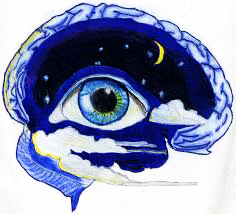
The phrase "mind's eye" refers to the human
ability to visualize, i.e., to experience visual mental imagery; in other
words, one's ability to "see" things with the mind.
The brain converts the outside world into the minimum it
requires: a sense of three physical dimensions plus time. It can convey several
more dimensions, as Escher does in his visually paradoxical paintings, and it
can think abstractly about still more dimensions, as physicists sometimes do,
using mathematical symbols as mental handrails. Just as a two-dimensional
painting or photograph conjures up a four-dimensional world, the brain
envisions itself in space and time. But only as much space and time as it needs
to survive, given its senses and limits. I often wonder about the senses of life-forms
in other solar systems, how many dimensions their universe might seem to hold,
depending on their biology and culture. If they have a culture, and an
awareness of the outside world, and if they value truth.
We cannot know. Faith eases that strain. Faith in most
anything, but especially in religion, science, and love, because they're so
good at providing useful and pleasing patterns and rewards. Certainty feels sweet.
Especially the certainty of knowing who and what goes where in a chaotic world.
In the mind's eye, that ancient seat of imagining, neurons appear to branch
like trees, and angels have taffeta bird wings.
Oct 4, 2015
Supercell thunderstorm

Storm chasers photograph a spring supercell thunderstorm
near Texline, Texas. Supercells are severe, potentially dangerous storms that
have a vortex of rotating air known as a mesocyclone. They produce hail, strong
rain, and occasionally tornadoes. (National Geographic)
Sep 27, 2015
Ant's eyes and antennas

Most ants have two compound eyes, which
are made up of light-sensitive compartments called ommatidia. These
compartments work together to generate an image in the ant’s brain. Some types
of ants have three simple eyes, called ocelli, at the top of their heads.
Ocelli can detect light, but they do not form images. Different species of ants
vary in their ability to see: Some have well-developed sight, but others are
entirely blind. Sight is of little importance to those ants that spend all or
much of their lives underground.
Attached to the front of the head
is a pair of flexible, segmented appendages called antennae, which contain
organs of taste, smell, and touch. Each antenna is shaped like a human arm that
is bent at the elbow. This antennae shape is an identifying feature of ants.
Antennae are an ant’s main source of information about the world. When an ant
is active, its antennae are in nearly constant motion—tapping the ground or
vegetation, other ants, and food sources, or sampling odors from.
(Encarta
Encyclopedia)
Sep 20, 2015
American Wars – battle deaths and cost

The cost (in 2008 dollars) and the numbers of American casualties
in various wars:
American Revolution (1775-1783): $1.825 billion; between
4,400 and 6,800 battle deaths
War of 1812 (1812-1815): $1.177 billion; 2,260 battle deaths
Mexican War (1846-1849): $1.801 billion; 1,733 battle deaths
Civil War - Union (1861-1865): $45.199 billion; 140,414
battle deaths
Civil War - Confederacy (1861-1865): $15.244 billion; 94,000
battle deaths
Spanish-American War (1898-1899): $6.848 billion; 385 battle
deaths
World War I (1917-1918): $253 billion; 53,513 battle deaths
World War II (1941-1945): $4.114 trillion; 292,131 battle
deaths
Korean War (1950-1953): $320 billion; 33,629 battle deaths
Vietnam War (1965-1975): $686 billion; 47,393 battle deaths
Persian Gulf War (1990-1991): $96 billion; 146 battle deaths
Afghanistan War (2001- ): $321.3 billion; 906 battle deaths
Iraq War (2003- ): $739.8 billion; 3,489 battle deaths
The costs do not include veterans' benefits, war debts, or
assistance to our allies; casualties do not include civilians, noncombat deaths,
those wounded or missing in action. (Information for the Iraq and Afghanistan
wars is correct as of August 5, 2010.)
- Kee
Malesky (‘All Facts Considered’)
Sep 13, 2015
Out of Africa
 The first African to come to the New World may have been
Pedro Alonzo Nino (1468-1505?), who was not a slave but a pilot and a navigator
for Christopher Columbus on his first voyage. It's possible that there were
earlier trading contacts between Africa and the Americas, but historians are
still debating the evidence. Africans were certainly involved in other European
explorations: thirty black men were with Vasco Nunez de Balboa when he reached
the Pacific Ocean in 1513; Africans accompanied Hernando Cortes to Mexico and
Francisco Pizarro to Peru; and they ventured into Canada and the Mississippi
Valley with the French. And, around 1780 or 1790, it was a black man from
Haiti, Jean Baptiste Point du Sable, who constructed the first non-Native
dwelling at a trading post that would later be named Chicago.
The first African to come to the New World may have been
Pedro Alonzo Nino (1468-1505?), who was not a slave but a pilot and a navigator
for Christopher Columbus on his first voyage. It's possible that there were
earlier trading contacts between Africa and the Americas, but historians are
still debating the evidence. Africans were certainly involved in other European
explorations: thirty black men were with Vasco Nunez de Balboa when he reached
the Pacific Ocean in 1513; Africans accompanied Hernando Cortes to Mexico and
Francisco Pizarro to Peru; and they ventured into Canada and the Mississippi
Valley with the French. And, around 1780 or 1790, it was a black man from
Haiti, Jean Baptiste Point du Sable, who constructed the first non-Native
dwelling at a trading post that would later be named Chicago.
- Kee Malesky (‘All Facts Considered’)
Sep 6, 2015
Semblance of two worlds

Aug 30, 2015
2015: Still leaning…

Looks like the Leaning Tower of Pisa will keep on leaning, stably,
awhile longer. More than a dozen years after major foundation work, the
imperfect edifice hasn't increased its lean. In fact, civil engineer John
Burland of Imperial College London says his international team has succeeded in
straightening the marble bell tower by 19 inches, reducing its angle of incline
by about 10 percent, and slowing its once steady creep to nearly nothing. It
wasn't easy. Built from 1173 to 1370 on silt and clay, the eight-story, 182- foot-tall
tower resisted many efforts to stabilize it. What finally worked was a soil removal
process called under-excavation and the addition of wells to regulate groundwater.
The chief fear now? A big earthquake. "Absent that," says Burland,"
I'd be very surprised indeed if we see it lean significantly again."
- Jeremy
Berlin (National Geographic magazine)
Aug 23, 2015
Modern Medicine

In the 19th century, sound scientific thinking and new medical technologies led to advances in every area of medicine, particularly the eradication of many of the world's worst diseases. Of fundamental importance was the discovery of a connection between filth and disease, and public acceptance of the theory led to improved sanitation and other public health measures. Independently established by Louis Pasteur and Robert Koch in the 1870s, the germ theory of disease,
which holds that bacteria and other microbes cause and spread infectious diseases,
enabled scientists to isolate the causative agents of diphtheria, tuberculosis,
and other scourges, leading to the development of vaccines. In 1879, Pasteur accidentally
discovered that bacteria could be weakened, which prevents them from causing disease
but still enables them to trigger immunity in infected individuals. Using
weakened anthrax bacteria taken from the blood of diseased animals, Pasteur
developed the first artificially produced vaccine in 1881. Vaccines for rabies (1885),
cholera (1893), plague (1897), and typhoid (1897) soon followed.
Many new drugs were developed at this time, including acetylsalicylate,
a derivative of the active ingredient in willow bark, a remedy used for combating
fever for more than 2,000 years. Now known as "aspirin," it went on the
market in 1899 after development by the German pharmaceutical company Bayer. Other
drugs to appear in the physician's medicine cabinet included digitalis for heart
ailments, amyl nitrate for angina, quinine for malaria, and sedatives such as chloral
hydrate and paraldehyde.
Aug 16, 2015

Aug 9, 2015
Oldest man - 2015

Japanese Yasutaro Koide , 112, receives the Guinness World
Records certificate as he is formally recognized as the world's oldest man, at
a nursing home in Nagoya, central Japan. (Reuters)
(http://www.independent.co.uk/news/science)
Aug 2, 2015
The largest oil field in the world

The
Ghawar field, discovered in 1948 in Saudi Arabia, is the largest oil field in
the world; it measures 174 by 19 miles and is located in the
eastern area of Saudi Arabia near the Persian Gulf. It accounts for more than
half of the cumulative oil production of Saudi Arabia. Ghawar is entirely owned
and operated by Saudi Aramco, the state run Saudi oil company. Saudi
Aramco's value has been estimated at anywhere between US$1.25 trillion and
US$7 trillion, making it the world's most valuable company. Saudi Aramco has the world's largest
proven crude oil reserves, at more than 260 billion barrels. Its 2013 crude oil production totaled 3.4
billion barrels from 100 oil fields.
(Adapted from ‘The Handy Science Answer Book, compiled by the Science and
Technology department of the Carnegie Library of Pittsburgh; and from Wikipedia
encyclopedia)
Jul 26, 2015
Capitalism

Capitalism
is an economic system in which most of the industries and businesses in a
country are owned privately, rather than by the government. Capitalists are
people who use their own wealth (or other people's money) to make more wealth.
The extra money they make is their profit. Some capitalists manufacture things
to sell at a profit. Some are store owners who sell goods at a profit. Others
are financiers or investors who lend their money in the hope of getting more
back.
No
matter what their business, the aim of capitalists is to make a profit. But
this does not mean that they can charge very high prices or sell bad goods. If
they do, they will
probably lose business to others who sell better goods or have lower prices.
Competition forces capitalists to sell the best possible goods at the lowest
possible price. Competition is an important feature of capitalism. The profits
made by individual capitalists in free competition benefit the economy of a
whole country. As capitalists make profits they can expand their businesses and
put more people to work.
Early Capitalism
In the
Middle Ages, Europe had a feudal agricultural system. Land belonged to the
church and to the nobles and was worked mainly by serfs. Few people were free
to own and control their own businesses except in the cities.
Jul 19, 2015
Why We Ask "Why?"
 Sometimes as the fog of sleep lifts, the mind becomes aware
of its traffic. Like commuters on an expressway, messages speed across the corpus
callosum, a thick bridge of 200-250 million nerve fibers spanning the brain's
two hemispheres. More will follow in a continuous stream of hubbub going in
both directions. The brain is a duet of specialists which produces a single
experience that's part enterprise, part communion, but all process, all motion.
Sometimes as the fog of sleep lifts, the mind becomes aware
of its traffic. Like commuters on an expressway, messages speed across the corpus
callosum, a thick bridge of 200-250 million nerve fibers spanning the brain's
two hemispheres. More will follow in a continuous stream of hubbub going in
both directions. The brain is a duet of specialists which produces a single
experience that's part enterprise, part communion, but all process, all motion.
The right brain is the strong silent one. It can see and act,
but not report. Only the left brain talks, and it jabbers all day long, in a
self-styled monologue and running commentary on the world, punctuated by
conversations with other folk blessed (or cursed) with equally gabby left
brains. What's more, the two sides specialize in different facets of mind, with
the left excelling at speech and language and the right better at visual-motor
skills. Heavy lifting is fine, but don't ask the right brain to solve knotty verbal
problems. Which is not to say that the right side doesn't process language - it
does, but weakly compared with the
eloquent feats of the left. Damage the left hemisphere and language becomes a night-
mare, especially for men (women generally recover better from left hemisphere injuries).
But people vary greatly and the brain is resilient, so, fortunately, some
victims with injured left brains do manage to regain speech. Mind you, that
doesn't necessarily mean they can write. As it happens, writing isn't much
related to speaking. A relatively recent invention, it's not part of our evolutionary
heritage, but more like a sophisticated team sport with changing equipment and rules.
Jul 12, 2015
The Corinth Canal in Greece
 The Corinth Canal in Greece is a deep-ditch ship canal, connecting
the Ionian and Aegean seas. Built between 1882 and 1893, the canal is only 4
miles (6.3 kilometers) long. But for most ships, it saves a 202-mile (325-kilometer)
voyage around southern Greece. The canal has no locks because its entire length
is at sea level.
The Corinth Canal in Greece is a deep-ditch ship canal, connecting
the Ionian and Aegean seas. Built between 1882 and 1893, the canal is only 4
miles (6.3 kilometers) long. But for most ships, it saves a 202-mile (325-kilometer)
voyage around southern Greece. The canal has no locks because its entire length
is at sea level.
(The Book of Knowledge encyclopedia)
Jul 5, 2015
1867: The formation of the Dominion of Canada

In 1864, the "Fathers of the Confederation"
met in Quebec to discuss the union of Britain's North American colonies. Three years
later the Dominion of Canada was founded. The Provinces that were part of
Canada in 1867 were: Quebec, Ontario, Nova Scotia, and New Brunswick.
(Adapted
from ‘The Book of Knowledge Encyclopedia and http://www.worldatlas.com)
Jun 28, 2015
The Peopling of the World
 Scientists today estimate that the Earth is 4.6 billion years
old, but that number has shifted more than a few times over the last century. The
earliest signs of human activity did not appear until 2.7 million years ago, in
the early Stone Age (or Lower Paleolithic era), which lasted until 200,000
years ago, although the species called Australopithecus dates back more than 4 million
years ago. Africa is often referred to as "the cradle of humanity," and
all the fossil discoveries were made there.
Scientists today estimate that the Earth is 4.6 billion years
old, but that number has shifted more than a few times over the last century. The
earliest signs of human activity did not appear until 2.7 million years ago, in
the early Stone Age (or Lower Paleolithic era), which lasted until 200,000
years ago, although the species called Australopithecus dates back more than 4 million
years ago. Africa is often referred to as "the cradle of humanity," and
all the fossil discoveries were made there.
The earliest human ancestors--called hominids--walked upright
on two legs and were scavengers. Homo erectus,
another early hominid dating from 1.5 million years ago, evolved in Africa
but migrated to Eurasia, the first human species to do so. These very early humans
used fire (but probably could not make it), created stone weapons and tools, and
were successful in occupying a wide range of habitats. Nevertheless, all non-African
populations of Homo erectus eventually
died out without leaving descendants.
Our own species, Homo sapiens,
evolved from Homo erectus
through various transitional stages in the savannah lands of eastern
Africa about 150,000 years ago. Homo sapiens
is a highly social and adaptable species, fully capable of using complex
language. Modern humans moved out from the original species' homeland on the eastern
plains of Africa to occupy much of eastern, northern, and southern parts of the
continent. The special challenges of the rain forest environment slowed the movement
of humans into the western regions of Africa.
Around 105,000 years ago, modern humans migrated northward through
Egypt and out of Africa via the Sinai Peninsula to the Middle East. There they
apparently met and coexisted with humans of a different and older species - Neanderthals
(Homo neandertalensis)-- that had
a simpler, less flexible culture and technology.
Jun 14, 2015
The art and beauty of the brain
 Imagine the brain, that shiny mound of being, that mouse-gray parliament of cells, that dream factory, that petit tyrant inside a ball of bone,
that huddle of
neurons calling
all the plays,
that little everywhere,
that fickle pleasuredrome, that wrinkled
wardrobe of selves stuffed into the skull like too many clothes into a gym bag. The neocortex has
ridges, valleys, and folds because the brain kept remodeling itself though space was tight. We
take for granted the ridiculous-sounding yet undeniable fact that each person carries around
atop the body
a complete
universe in which trillions of sensations, thoughts, and desires stream. They mix privately,
silently, while agitating on many levels, some of which we're not aware of, thank heavens. If we needed to remember how to
work the bellows of the lungs or the writhing python of
digestion, we'd be swamped by formed and forming memories, and there'd be no time left for buying cute
socks. My
brain likes cute socks. But it also
likes kisses. And asparagus. And watching boat-tailed grackles. And biking. And drinking Japanese green tea in a rose garden. There's
the nub of it-the
brain is personality's whereabouts. It's also a stern warden, and, at times,
a self-tormentor. It's where catchy tunes snag, and
cravings keep tugging. Shaped a little like a loaf of French country bread, our
brain is a crowded chemistry lab, bustling with nonstop neural conversations. It's
also an impersonal landscape where minute bolts of lightning prowl and strike. A
hall of mirrors, it can contemplate existentialism, the delicate hooves of a
goat, and its own birth and death in a matter of seconds. It's blunt as a skunk,
and a real gossip hound, but also voluptuous, clever, playful, and forgiving.
Imagine the brain, that shiny mound of being, that mouse-gray parliament of cells, that dream factory, that petit tyrant inside a ball of bone,
that huddle of
neurons calling
all the plays,
that little everywhere,
that fickle pleasuredrome, that wrinkled
wardrobe of selves stuffed into the skull like too many clothes into a gym bag. The neocortex has
ridges, valleys, and folds because the brain kept remodeling itself though space was tight. We
take for granted the ridiculous-sounding yet undeniable fact that each person carries around
atop the body
a complete
universe in which trillions of sensations, thoughts, and desires stream. They mix privately,
silently, while agitating on many levels, some of which we're not aware of, thank heavens. If we needed to remember how to
work the bellows of the lungs or the writhing python of
digestion, we'd be swamped by formed and forming memories, and there'd be no time left for buying cute
socks. My
brain likes cute socks. But it also
likes kisses. And asparagus. And watching boat-tailed grackles. And biking. And drinking Japanese green tea in a rose garden. There's
the nub of it-the
brain is personality's whereabouts. It's also a stern warden, and, at times,
a self-tormentor. It's where catchy tunes snag, and
cravings keep tugging. Shaped a little like a loaf of French country bread, our
brain is a crowded chemistry lab, bustling with nonstop neural conversations. It's
also an impersonal landscape where minute bolts of lightning prowl and strike. A
hall of mirrors, it can contemplate existentialism, the delicate hooves of a
goat, and its own birth and death in a matter of seconds. It's blunt as a skunk,
and a real gossip hound, but also voluptuous, clever, playful, and forgiving.
Subscribe to:
Posts (Atom)